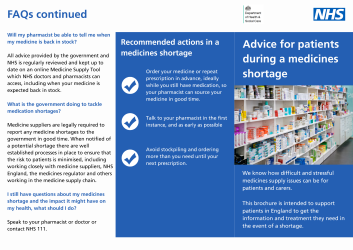
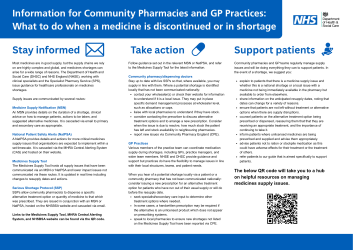
Poster titled ‘Information for Community Pharmacies and GP Practices: What to do when a medicine is discontinued or in shortage’. Headings: ‘Stay informed’, ‘Take action’, ‘Support patients’.
Text under heading stay informed:
“Most medicines are in good supply, but the supply chains we rely on are highly complex and global, and medicines shortages can arise for a wide range of reasons. The Department of Health and Social Care (DHSC) and NHS England (NHSE), working with clinical specialists and the Specialist Pharmacy Service (SPS), issue guidance for healthcare professionals on medicines shortages.”
Supply issues are communicated by several routes:
Medicine Supply Notification (MSN)
“An MSN provides details on the duration of a shortage, clinical advice on how to manage patients, actions to be taken, and suggested alternative medicines. It is cascaded via email to primary and secondary care as appropriate.”
National Patient Safety Alerts (NatPSA)
“A NatPSA provides details and actions for more critical medicines supply issues that organisations are expected to implement within a set timescale. It is cascaded via the MHRA Central Alerting System (CAS) and hosted on their website.”
Medicines Supply Tool
“The Medicines Supply Tool hosts all supply issues that have been communicated via an MSN or NatPSA and lower impact issues not communicated via these routes. It is updated in real time including changes to resupply dates and actions.”
Serious Shortage Protocol (SSP)
“SSPs allow community pharmacists to dispense a specific alternative treatment option or quantity of medicine to that which was prescribed. They are issued in conjunction with an MSN or NatPSA, hosted on the NHSBSA website and cascaded via email.”
“Links to the Medicines Supply Tool, MHRA Central Alerting System, and NHSBSA website can be found via the QR code.”
Text under heading take action:
Community pharmacy / dispensing doctors
“Stay up to date with live SSPs so that, where available, you may supply in line with them.”
“Where a potential shortage is identified locally that has not been communicated nationally:”
- “contact your wholesaler(s) or check their website for information to understand if it is a local issue. They may put in place specific demand management processes at wholesaler level, such as allocations or caps.”
- “liaise with local pharmacies to understand if they have stock.”
- “consider contacting the prescriber to discuss alternative treatment options and to arrange a new prescription.”
- “Consider when the issue is due to resolve, how much stock the patient has left and stock availability in neighbouring pharmacies.”
- “report new issues via Community Pharmacy England (CPE).”
GP Practices
“Various members of the practice team can coordinate medication supply during shortages, including GPs, practice managers, and wider team members.”
“NHSE and DHSC provide guidance and support but practices do have the flexibility to manage issues in line with their local structures, teams, and patient needs.”
“When you hear of a potential shortage locally via a patient or a community pharmacy that has not been communicated nationally:”
- “consider issuing a new prescription for an alternative treatment option for patients who have run out of their usual supply or will do before the resupply date.”
- “seek specialist/secondary care input to determine other treatment options where needed.”
- “In some cases, a handwritten prescription may be required if the alternative is an unlicensed product which does not appear on prescribing systems.”
- “speak to local pharmacies to ensure new shortages not listed on the Medicines Supply Tool have been reported via CPE.”
Text under heading supporting patients:
“Community pharmacies and GP teams regularly manage supply issues and will be doing everything they can to support patients.”
“In the event of a shortage, we suggest you:”
- “explain to patients that there is a medicine supply issue and whether this is a national shortage or a local issue with a medicine not being immediately available in the pharmacy but available to order from elsewhere.”
- “share information on the anticipated resupply dates, noting that dates can change for a variety of reasons.”
- “ensure that patients are not left without treatment or alternative options when there are supply disruptions.”
- “counsel patients on the alternative treatment option being prescribed or dispensed, reassuring them that they are receiving an appropriate treatment, and the importance of continuing to take it.”
- “inform patients where unlicensed medicines are being prescribed and supplied and advise them appropriately.”
- “advise patients not to ration or stockpile medication as this could have adverse effects for their treatment or the treatment of others.”
- “refer patients to our guide that is aimed specifically to support patients.”